
Unions, associations & membership
Union, Association & Membership Mailing Services
Plavidian produces member communications, election mail, benefit notices, renewals and advocacy mail for labor unions, trade associations, membership organizations and advocacy groups throughout California and nationwide. Membership files are messy in specific, predictable ways, and the data work is most of the job.
What membership files usually contain
- Members carried on two lists under two spellings
- Retirees and actives with different mail rules
- Chapters and locals with overlapping territories
- Households with two members and one mailbox
- Renewal dates that vary member by member

Member data
Deduplication, householding, segmentation
We reconcile membership exports against each other, deduplicate across lists, household where a mailing should arrive once per address, and segment by local, chapter, classification, status or region. Suppression rules travel with the job rather than being reapplied by hand each time.
Two members, one mailbox
Households containing two members are common in unions and near-universal in professional associations where spouses hold separate memberships. Whether that address receives one piece or two is a policy decision, not a technical one, and it usually differs by mailing type: one newsletter per household, but two ballots, because each member votes. We apply the rule per mailing rather than per organization, and report how many records were collapsed so the count reconciles against your membership numbers.
When the roster and the territory disagree
Members are assigned to a local or chapter in your system, but they live wherever they live. For regional communications those two facts conflict often enough to matter: a member assigned to one local whose address falls in another local territory. We can mail by assignment, by geography, or by assignment with a geographic exception list, and the right answer depends on whether the mailing is about representation or about an event someone has to physically attend.
Overlapping lists, priority order, one mail file
Cascade Priority Data Merge deals with the exact problem membership files create: several lists describing overlapping people, where the answer to "who gets which piece" depends on priority order rather than on any single file. The method is the same whether the overlap is voter lists or an actives file, a retirees file and a chapter roster that disagree about three thousand names.
Election mail
Ballots, notices and deadlines
Officer elections and ratification votes carry hard dates and eligibility rules. Eligibility is a field, mailing is scheduled backward from the deadline, and with camera verification added to a letter-size job, every piece is verified against the member record it was built from.
Recurring programs
Monthly and quarterly communications
Newsletters, benefit notices and renewal cycles run on a schedule. Once the data rules are established, each cycle repeats against a fresh export instead of being rebuilt. A newsletter or renewal cycle can also run as a repeat mailing program: we set it up once from your first order, and before each drop you get an email to confirm it, skip it or send new art.
Postage
Where nonprofit rates get missed
Many unions and other eligible nonprofits qualify for nonprofit rates and mail at commercial rates anyway, either because nobody applied or because the authorization belongs to the national office, which a local can use only when it is part of the same organization or the national is the mail owner. Trade associations and chambers of commerce are not eligible. It is worth checking before the next cycle; on a recurring newsletter the difference compounds every month.
Membership programs
What membership organizations actually mail
- Officer elections and ratification votes
- Eligibility rules, hard deadlines, and a mailing that has to be defensible if the result is contested.
- Newsletters and member magazines
- Recurring, often flat-size, frequently with regional versions by local or chapter.
- Benefit and plan notices
- Statutory timing, plan-specific content, and household rules that differ from marketing mail.
- Dues renewals and lapse recovery
- Renewal date varies per member, so the mailing is a rolling program rather than a single drop.
- Advocacy and legislative alerts
- Fast turnarounds keyed to a legislative calendar, often with reply devices to elected officials.
- Recruitment and organizing mail
- Worksite or geographic targeting, frequently against lists that are not yet clean.
One connected workflow
Data to proof, one provider
Most mailings cross three or four vendors. Every handoff is a place where a list changes, a piece goes missing, or nobody can say what actually happened. Plavidian runs these steps in one workflow, with one set of records.
-
Choose who gets it
Count households by radius, ZIP, city or district in the Mailing List Builder, or pick carrier routes for EDDM. A list you bring is cleaned with CASS, NCOA and deduplication before anything prints. The Mail Date Planner works the schedule back from the in-home date you want.
- Mailing List Builder Free
- EDDM Route Builder Free
- Mailing Blueprint Free account
- Mail Date Planner Free
Mailing Blueprint Free account 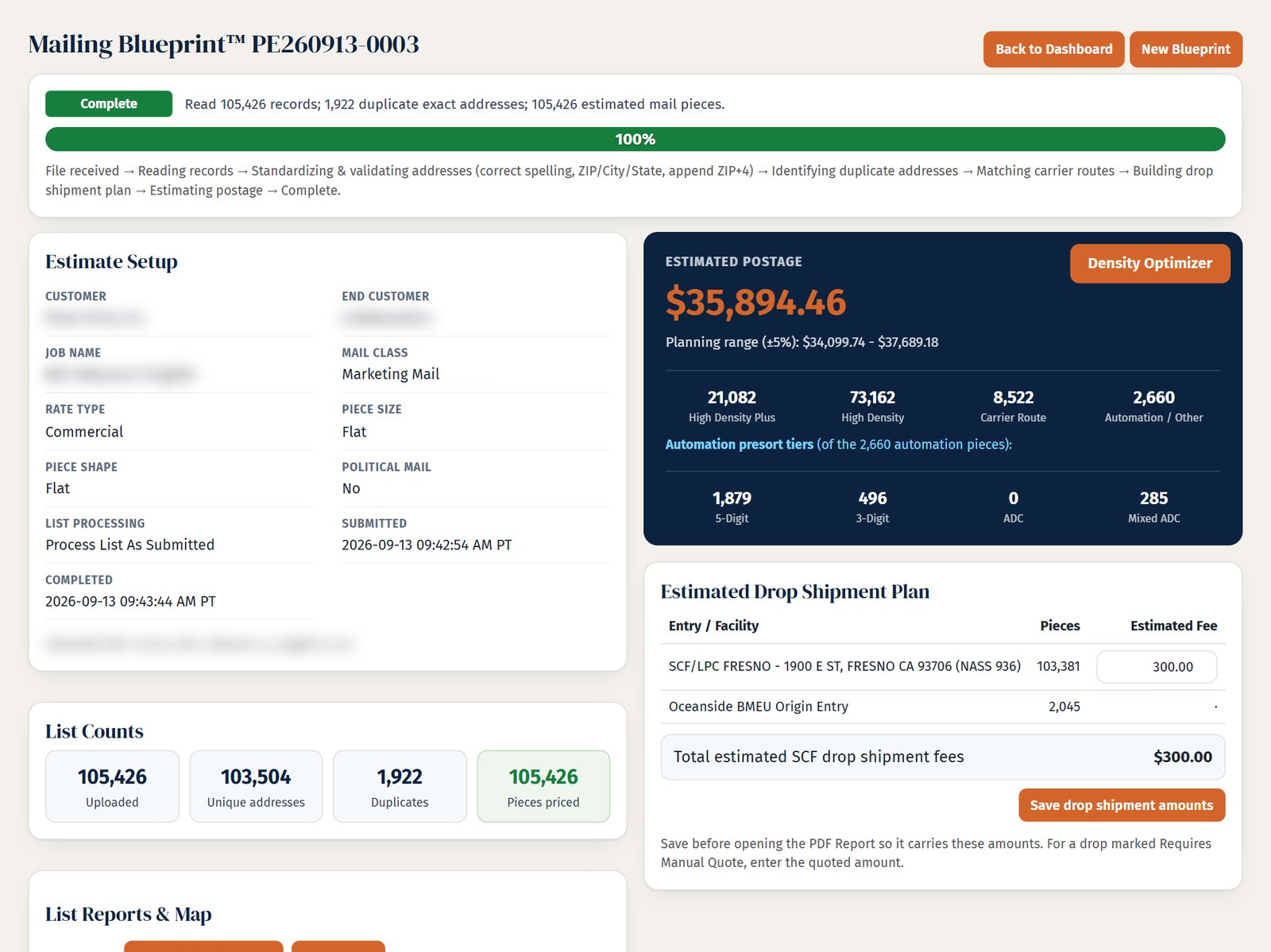
-
Printed and addressed in Vista
Postcards, letters, self-mailers, and booklets, versioned per record, then folded, inserted, tabbed and addressed. Presort, tray and pallet prep and Full-Service electronic documentation follow, then acceptance and drop shipment. Every mailing runs through the same five production steps, written down in the Plavidian Standard.
How mail is prepared: the Plavidian StandardPrint File Check No sign-in 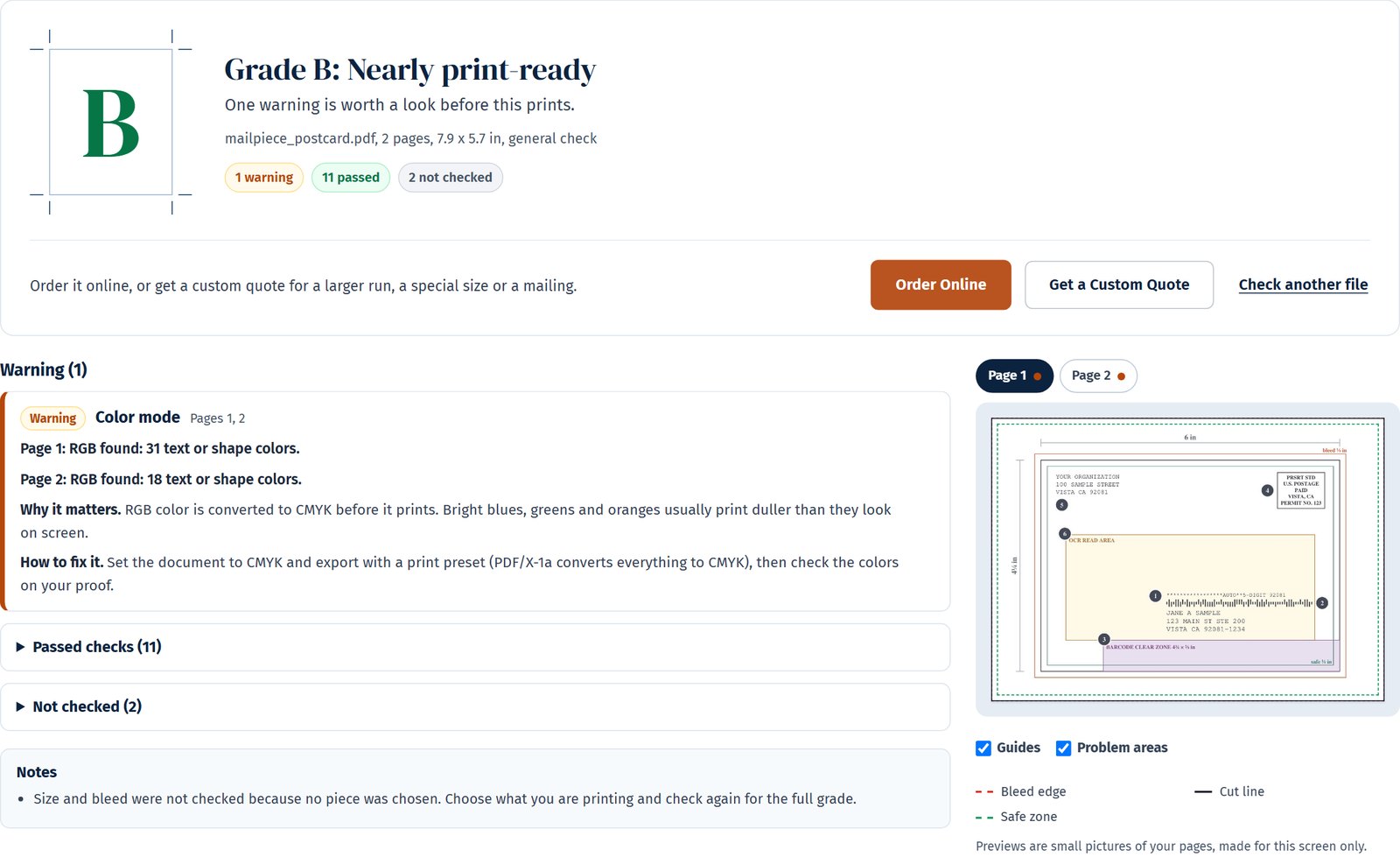
-
Checked as it runs
With Plavidian Sentry, an add-on for letter-size mail, a camera reads each piece as it runs and reconciles it to your list; pieces that fail are diverted for reprint. The Assurance Report documents what was produced and presented to USPS.
How camera verification worksAssurance Report, sample 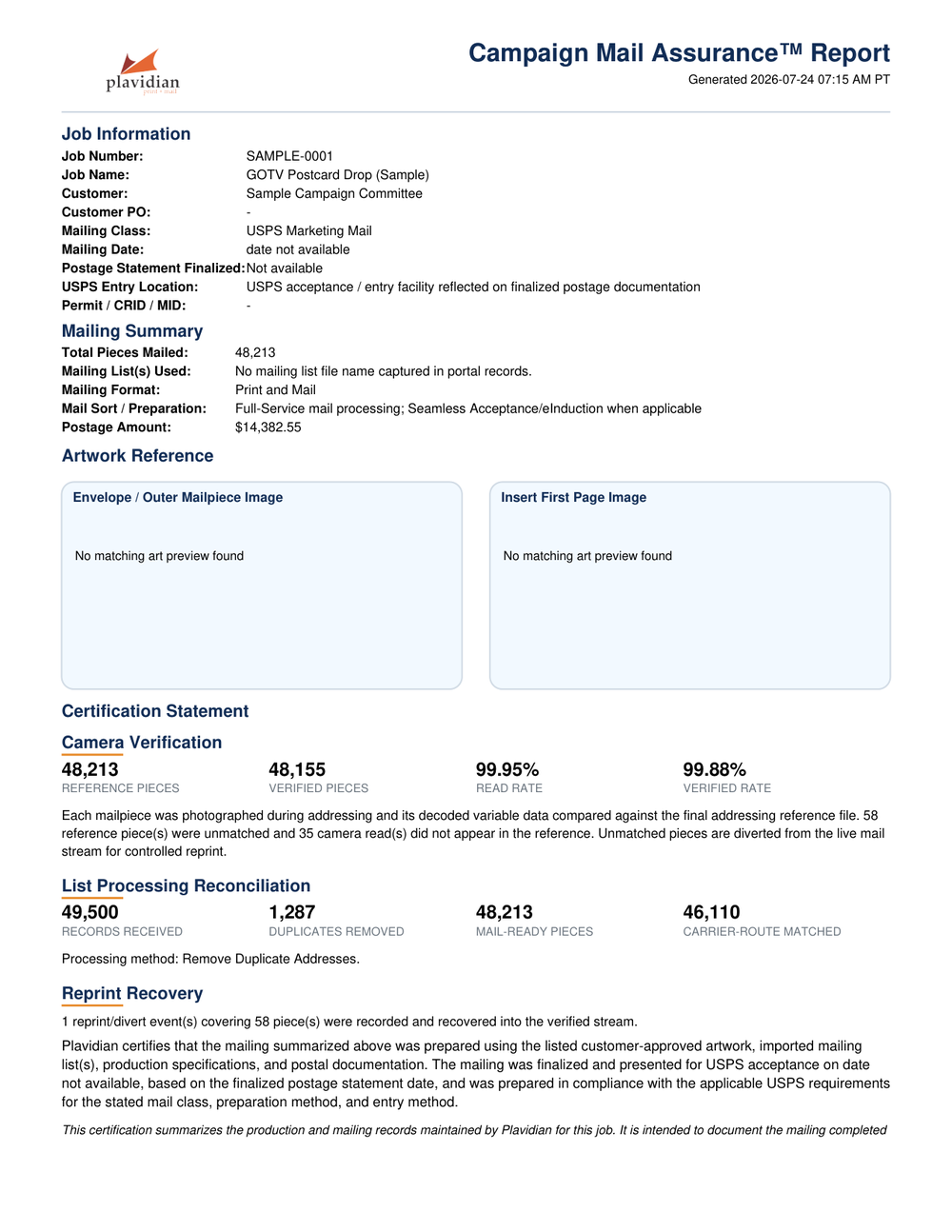
-
See where your mail is
Plavidian Insight is included with every addressed mailing: USPS scan events, a day-by-day delivery curve and delivery maps. The postage statement and the Insight tracking report come with the job. EDDM pieces carry no barcode, so EDDM jobs get the Assurance Report as proof of delivery to USPS.
See Plavidian InsightInsight delivery tracking Included 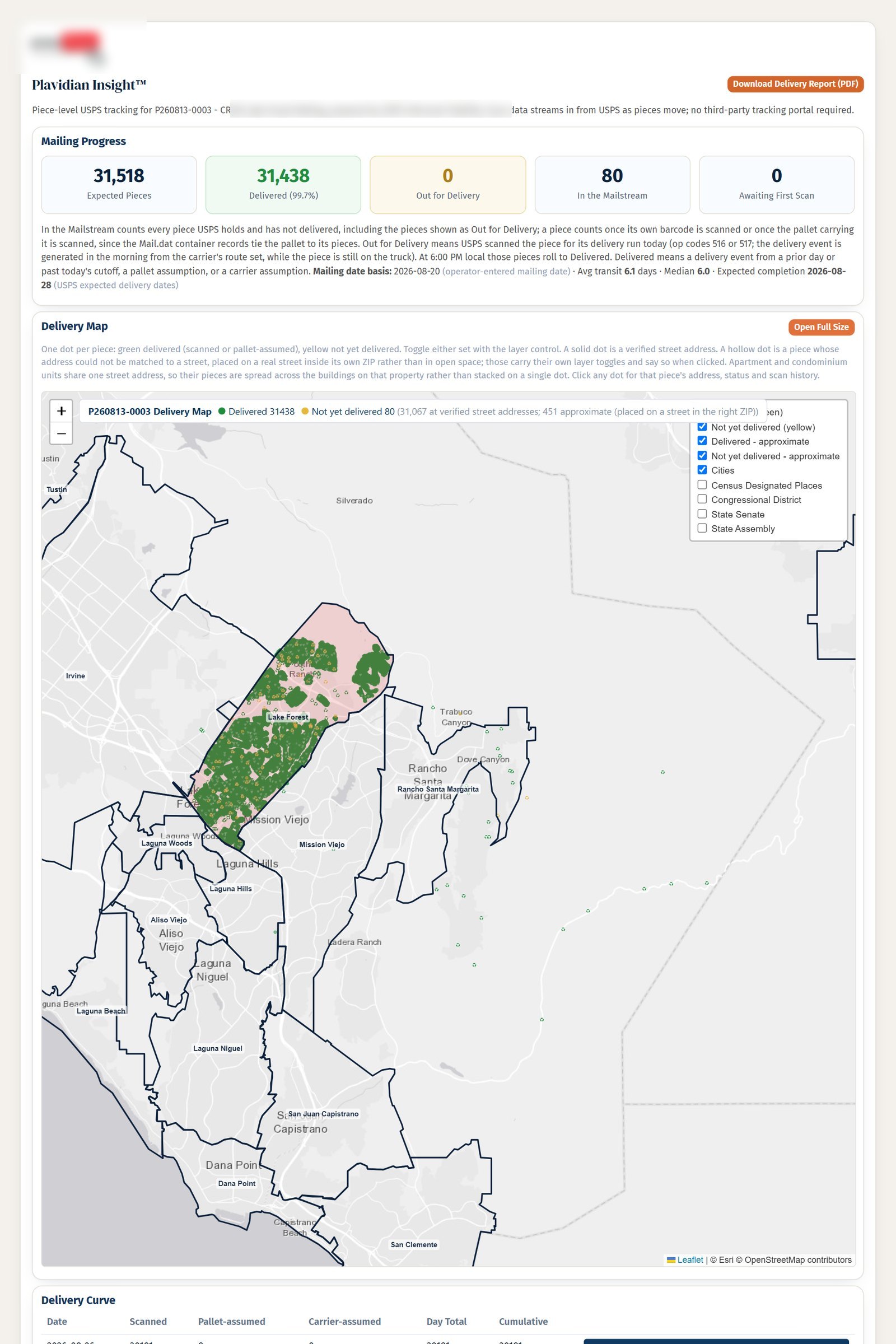
-
See who responded
Plavidian Response, an add-on for addressed postcards, self-mailers and flats, puts a short web address and QR code on each piece and counts visits, scans and form answers by day and ZIP on the job.
See Plavidian ResponseResponse Page builder Add-on 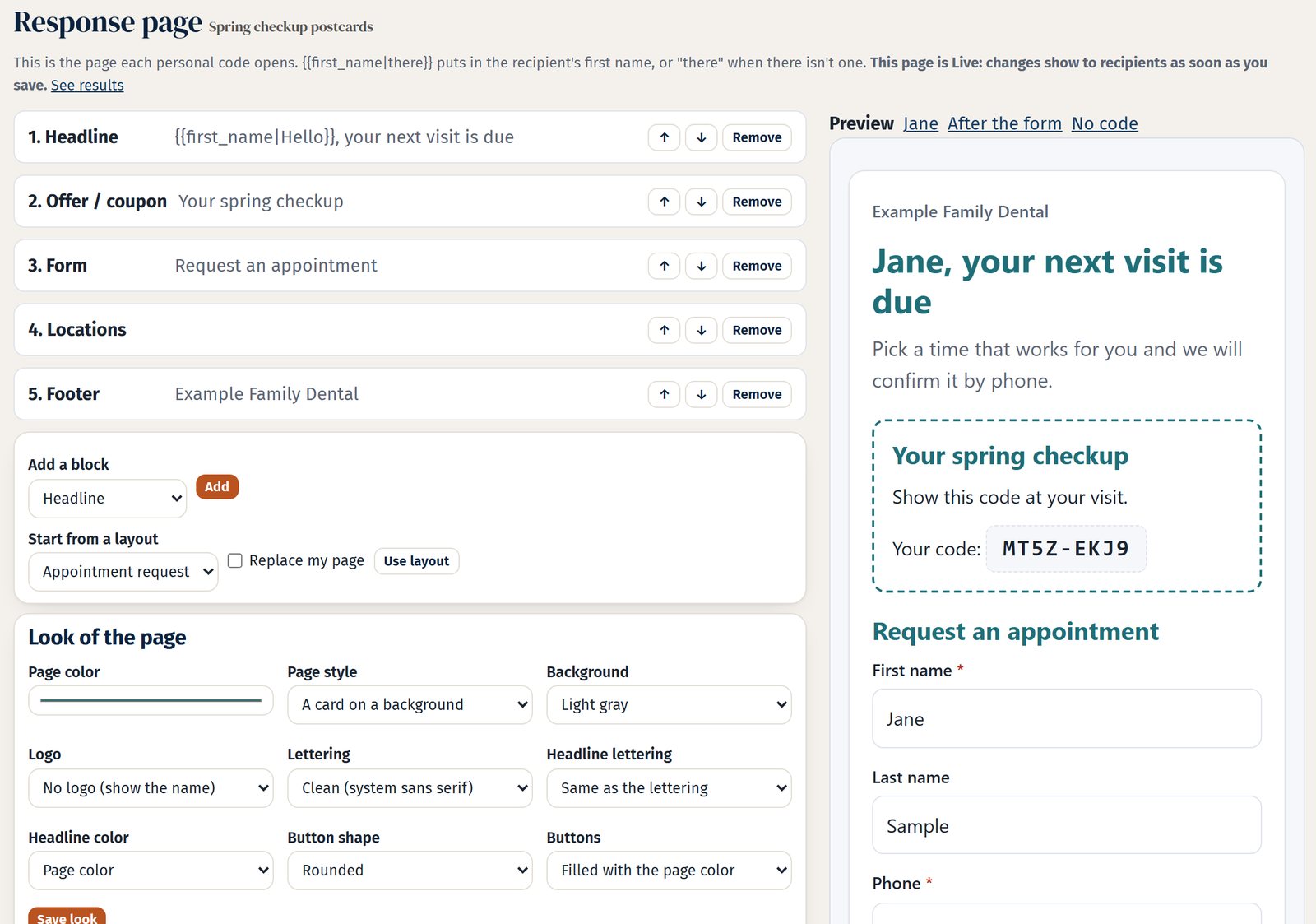


Questions
Frequently asked questions
Can you mail once per household rather than once per member?
Yes. Householding collapses members at the same address for mailings where one piece per household is appropriate, and leaves them separate where each member must receive their own.
Can different locals or chapters receive different content?
Yes. Chapter, local or region is a field in your file, and content varies piece by piece from it in a single production run.
Can you handle election or ratification mailings?
Yes, including eligibility segmentation and deadline-driven scheduling, with piece-level camera verification of what was mailed to whom available as an add-on for letter-size mail.
What if our membership data lives in two systems?
That is common. We reconcile the exports against each other and report what matched, what did not and what was suppressed before anything prints.
Our actives and retirees are in different systems. Is that a problem?
No. We reconcile the two exports, report what matched and what conflicted, and apply the rule you set for members who appear in both.
Can a mailing exclude members who already responded?
Yes. Send the response file and it becomes a suppression against the next drop, which is how renewal and lapse programs avoid mailing people who already paid.
Do you handle bilingual member communications?
Yes, selected per record within one production run.
Membership files are messy in predictable ways
We reconcile the exports against each other and report what matched, what did not and what was suppressed before anything prints.