
Piece-Level USPS Mail Tracking: See Every Piece Move Through the Mailstream
Plavidian Insight™ tracks each mailpiece by its Intelligent Mail barcode using USPS Informed Visibility scan data: live scan and delivery counts, a day-by-day curve, per-piece maps with district overlays, and a branded PDF report for your client or campaign. It is built into your Plavidian account, so there is no third-party portal to log into and no per-report fee.
How it works
We mail with Intelligent Mail barcodes
Every piece carries a unique IMb under Plavidian's USPS Full-Service Mailer IDs; every pallet carries an Intelligent Mail container barcode.
USPS scans stream in
Plavidian checks USPS Informed Visibility for new scan activity hourly and adds it to your report as your mail moves through processing and out to carriers.
You watch it move
Counts, curve, map, and report update in your Plavidian account. Look up any single piece by barcode, recipient, or address.
- Reconciled to your job
- Tracking lives on the same record as your proofs, postage, invoice and, when added, camera verification: one login, one story of the mailing.
- Names and addresses, not just barcodes
- Scans link to the actual recipient from your final mail file, so "did the piece to 25887 Crown Valley get there" is a search, not a support ticket.
- Included in the work
- Insight comes with every Plavidian mailing: no separate portal subscription, no per-mailing report fees.
What you see while your mail is in the mailstream
These are actual screens from Plavidian accounts, taken from live customer mailings.
What “delivered” means here: Insight shows a USPS Informed Visibility logical-delivery indication, based on mail-processing events (and, for carrier-route flats, pallet arrival at the delivery unit or, after a waiting period, the pallet's last unload scan), not a literal carrier delivery scan. It is mailstream visibility, not proof of delivery, and complete scan data is not guaranteed for every piece.
The delivery map: one dot per piece
Every dot is one mailpiece at its own street address, taken from your final mail file, not a ZIP-code blob. Green is delivered, yellow is still in the mailstream, and you can switch on jurisdictional boundaries: cities, Census places, Congressional, State Senate, and Assembly districts. For political mail this answers "how much of the district has landed" at a glance. Click a dot to see that piece's USPS scans, or open its full scan history.

Mailing progress, live
Expected pieces, pieces scanned, delivered counts, and pallet-assumed delivery, updating as USPS scan files arrive through the day.

Delivery by geography
Roll-ups by ZIP area with delivered counts, percentages, and first and last delivery dates, so a statewide mailing reads as cleanly as a local one.

The delivery curve
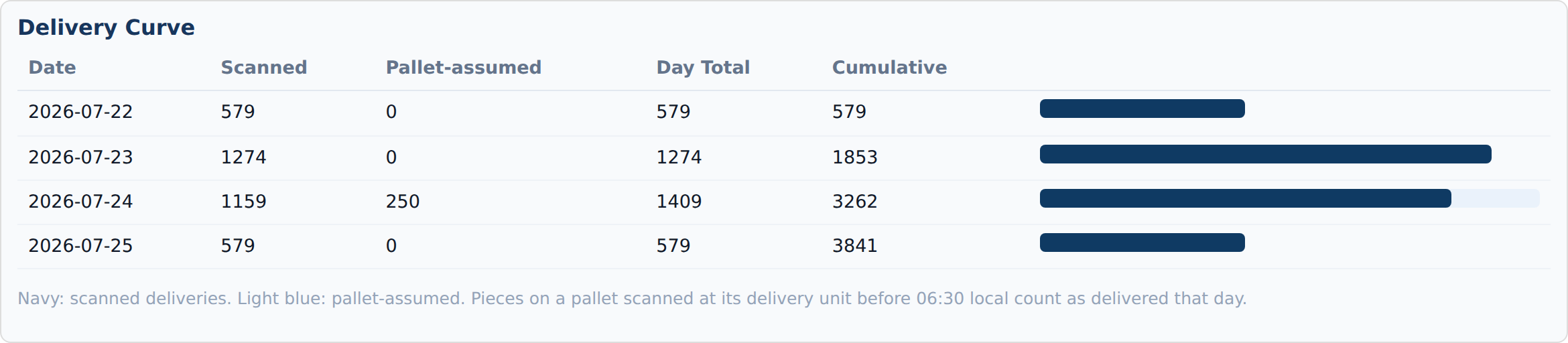
Day by day: how much delivered, how much of that was scanned at the carrier level versus assumed from pallet arrival, and the cumulative percentage. This is the chart that answers "has it landed yet?"
Carrier route flats: tracking mail that gets few piece scans
Saturation and high-density carrier route flats ride as bundles on pallets straight toward the delivery unit, largely bypassing the piece-level sorting machines that generate scans. Tracking built on piece scans alone shows almost nothing for that mailing: induction, a few container-transfer scans, then days of "no scan data available" while the mail is in fact landing in mailboxes. Insight uses the pallet itself: every pallet's Intelligent Mail container barcode is registered from the job's Mail.dat, USPS scans the placard on arrival at the delivery unit, and an arrival before carriers leave in the morning marks that ZIP's flats delivered that day, labeled "pallet-assumed" and never overwriting a real carrier scan, on the map, the curve, and the report. Piece scans alone cannot show that delivery day.
EDDM is different. EDDM pieces carry no barcode, so Insight cannot track an EDDM mailing the way it tracks addressed mail. For EDDM, the Plavidian Assurance™ Report is the proof the mailing was delivered to USPS.
Pallet arrival and the early-morning rule
USPS scans the pallet placard when it reaches the delivery unit. When that scan lands before the carriers leave in the morning, Insight marks that ZIP's pieces as delivered that day, the same operating assumption postal logistics teams use. It is labeled "assumed" and never overwrites an actual carrier scan. A later arrival counts toward the next delivery day. Insight finds each pallet's delivery unit in USPS Mail Direction data, so a pallet entered at the office that serves its ZIP counts even when that office has a different ZIP code. If a pallet is unloaded from a USPS truck but never scanned at the delivery unit, Insight waits until the next delivery day has ended, then marks its pieces "Assumed (unload scan)", kept apart from pallet arrivals and replaced if a delivery-unit scan arrives. Trays that travel without a pallet are listed on their own, with their own USPS tray scans when USPS sends them.

A report you can hand to anyone
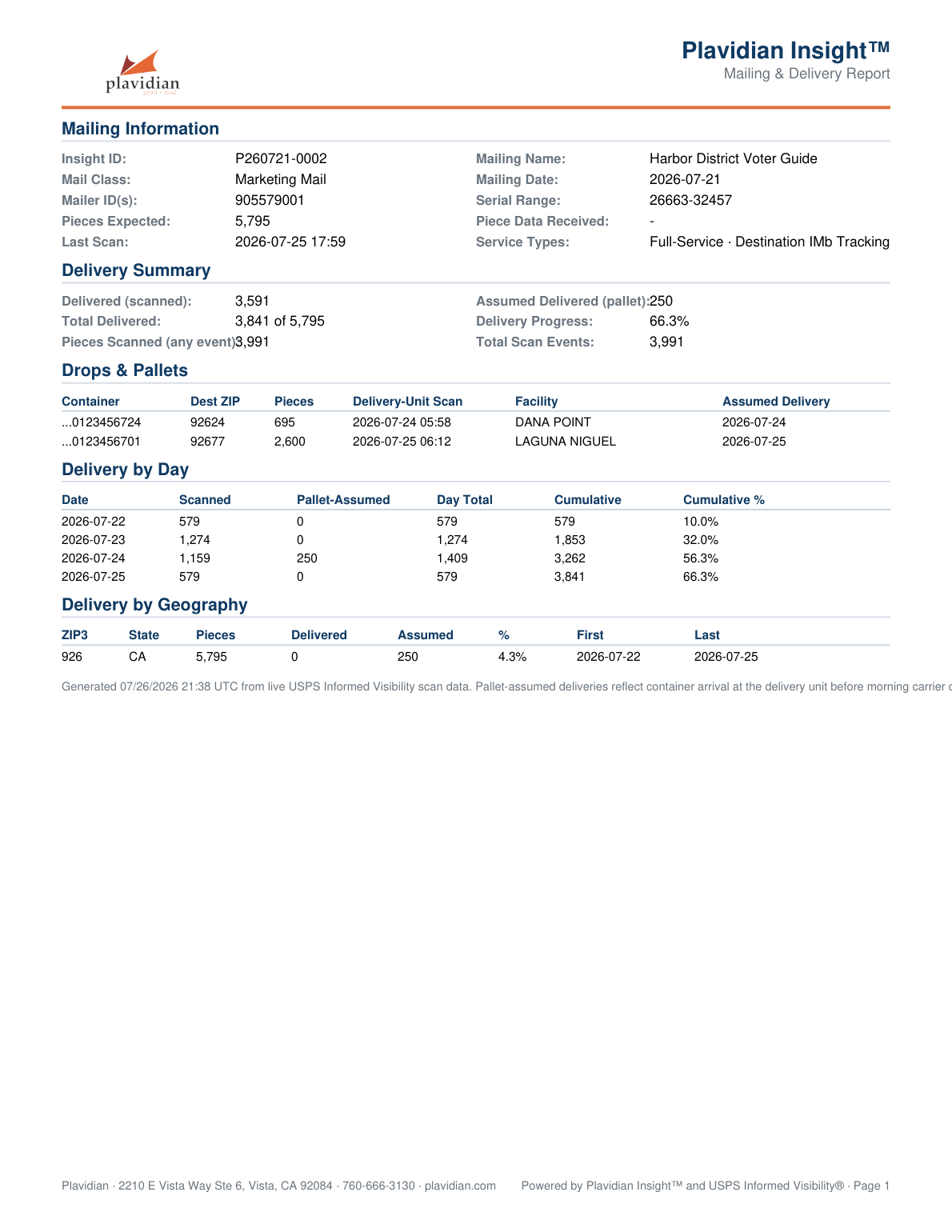
Every Plavidian mailing includes a downloadable Plavidian Insight™ Mailing & Delivery Report: a branded PDF with the mailing summary, drop and pallet detail, day-by-day delivery, and geography, generated on demand from live data. You can forward it to a client or committee as it is, with your job's numbers and our name behind it.
Questions
Frequently asked questions
How does Plavidian Insight track individual mailpieces?
Every piece carries a unique USPS Intelligent Mail barcode. USPS Informed Visibility streams scan events to Plavidian as the piece moves through processing and delivery, and Insight matches each scan to your job and recipient.
What does the delivery map show?
One dot per mailpiece at its street address: green for delivered, yellow for still in the mailstream, with optional overlays for cities, Census places, Congressional districts, and state legislative districts.
What is pallet-assumed delivery?
When USPS scans a pallet at the destination delivery unit before carriers leave in the morning, the pieces on it are assumed delivered that day. Insight labels these separately from carrier-scanned deliveries and never overwrites an actual scan. A pallet that arrives later counts toward the next delivery day, and a pallet unloaded from a USPS truck but never scanned at the delivery unit is marked 'Assumed (unload scan)' once the next delivery day has ended.
Can I download a delivery report?
Yes. Each Plavidian mailing includes a branded Plavidian Insight Mailing and Delivery Report PDF with the mailing summary, drops, delivery progress, and geography, generated on demand.
Does Insight cost extra?
No. Plavidian Insight is included with every Plavidian mailing: no separate tracking subscription and no per-report fee.
Every Plavidian mailing is tracked in Insight
Tell us about the project. Piece tracking, pallet visibility and the delivery report come with the mailing.
Related
Mail tracking and verified production
How mail is followed from the Intelligent Mail barcode printed on the piece to the USPS scans that show it reached delivery.
- what the Intelligent Mail barcode encodes
- Intelligent Mail barcodes and Informed Delivery guide
- Plavidian Insight piece tracking (encyclopedia)
- Plavidian Assurance reconciled production reports
- piece-level camera verification add-on (Plavidian Sentry)
- piece-level verified mail production explained
- political mail printing that is tracked and verified
- a tour of the Plavidian account
- Informed Delivery campaigns (Plavidian Impression)
- USPS service standards and in-home dates in 2026
- Plavidian Mailing Intelligence overview
Related
Political mail, end to end
Guides and services for campaigns, committees and elected offices, from voter data to delivery.
- political mail printing and direct mail services
- campaign mail printing for candidates and PACs
- franked mail for congressional offices
- political mail camera verification (Plavidian Sentry)
- voter files, district universes and mailing list targeting
- address list cleanup: standardization and deduplication
- variable-data printing and lettershop services
- USPS Full-Service Intelligent Mail
- planning a winning campaign mailing in 2026
- yard signs and door hangers for political campaigns
- USPS political mail guide: Tag 57, election mail rules
- CA-08 district demographic profile case study
- free postage planning with Mailing Blueprint
- Election HQ: California election mail calendar